
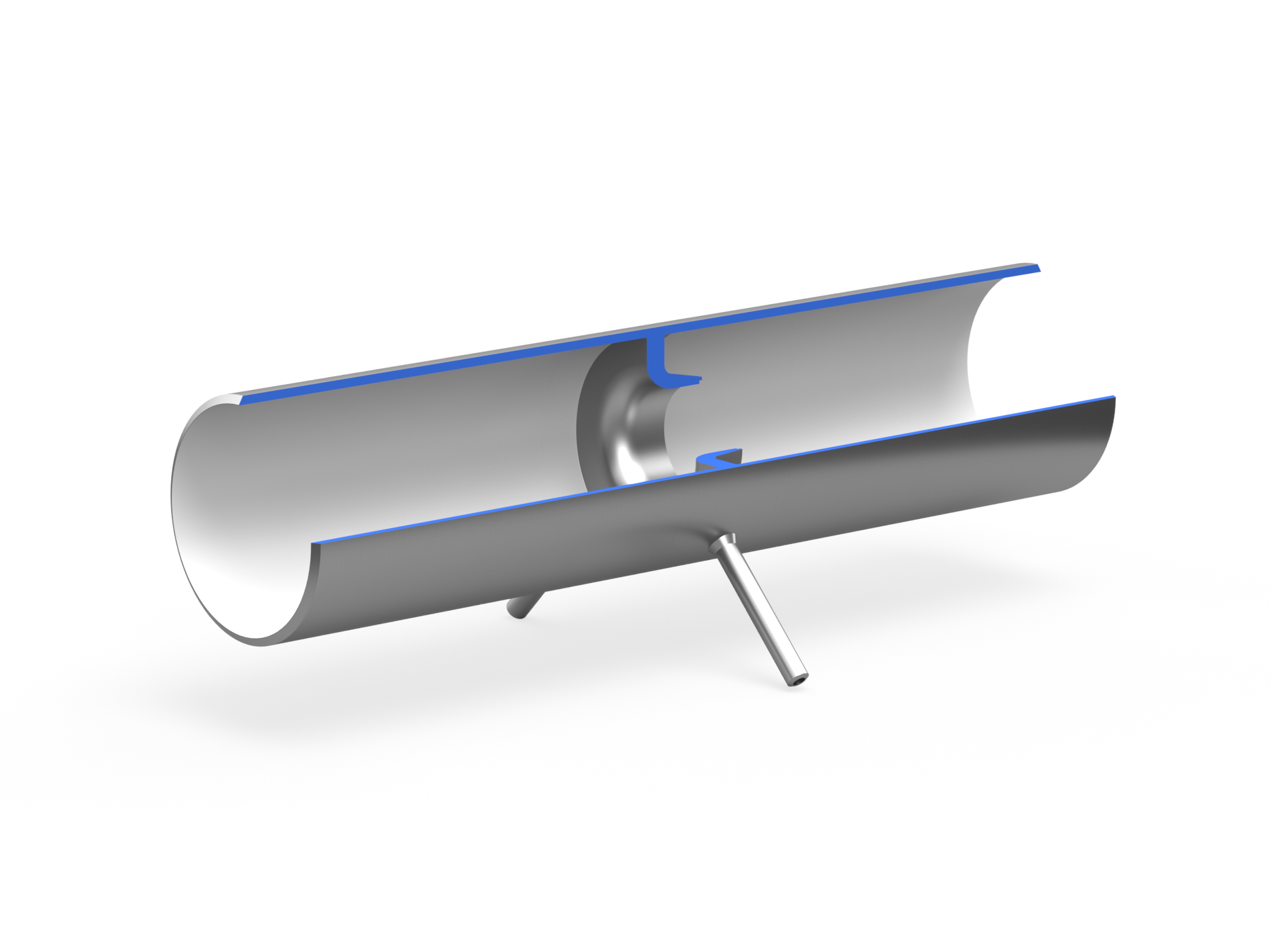
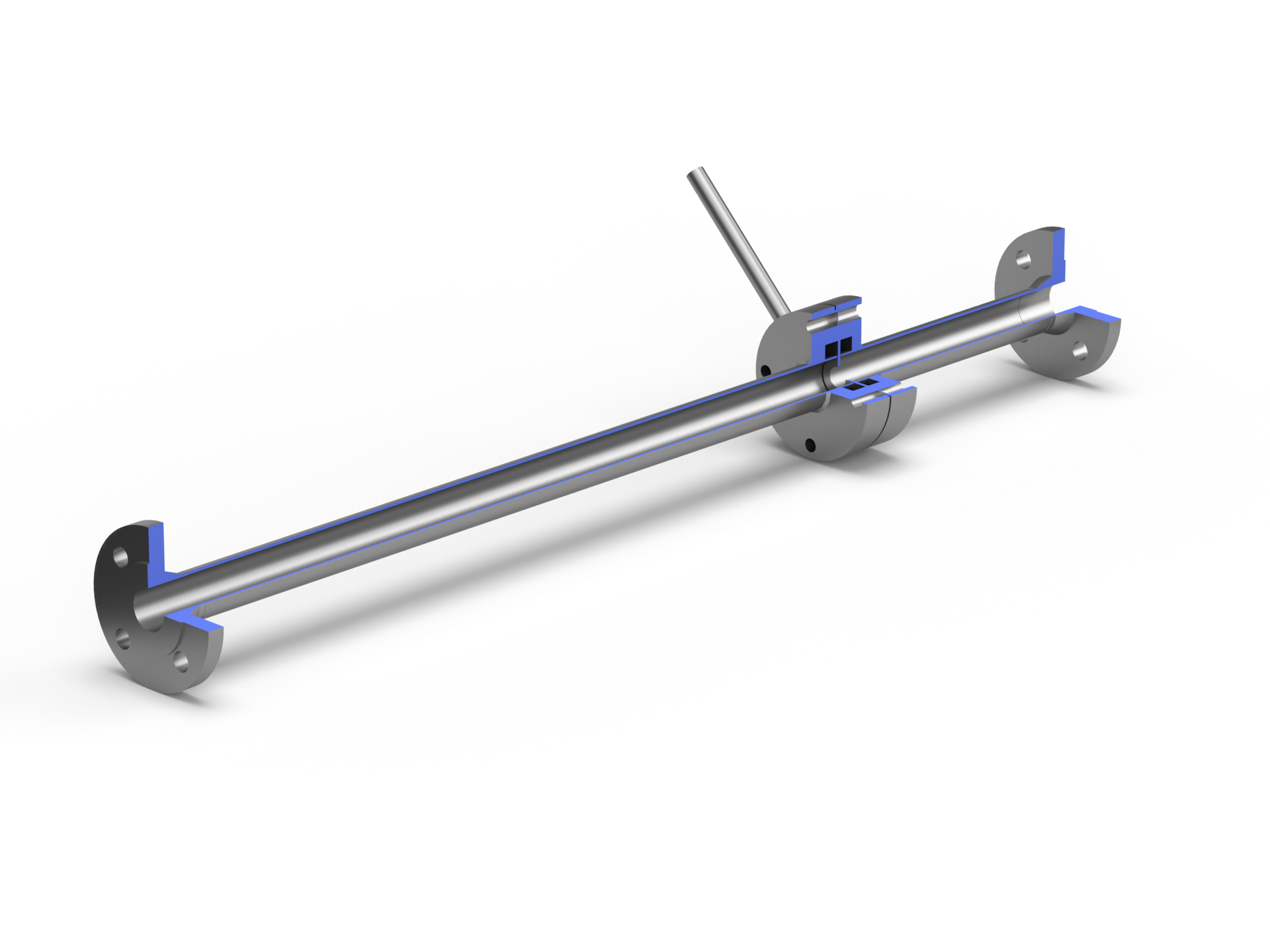
The ISA 1932 Nozzle is used for high velocity, non-viscous, erosive flows which would wear or damage an orifice plate. Typically nozzles have a larg capacity and well accuracy with high velocity flows.The required straight inlet section is much less than an orifice and the discharge coefficient of the nozzle is such that a nozzle can measure approximately 55% higher flow rates than an orifice plate with a similar beta ratio and design differential pressure. ISA 1932 Nozzles have a smooth centrical inlet leading to a throat section with sharp outlet. The length of the ISA Nozzle depends on the Beta-Ratio. The lower the ratio the less the length. The ISA 1932 Nozzle can also be clamped between flanges (within the bolt circle). Also the opportunity of a complete meterrun with a weld-in ISA 1932 Nozzle is possible. All design alternatives can be achieved with annular-chambers. There shall be used corner pressure taps upstream and downstream of the nozzle. These can be either single taps or annular slots. Depending on customer requirements, the typical 1/2 in. or 3/4 in. tappings have a but or socket weld, screw thread or flange connection. Tappings maybe equiped with condensate chambers and shut-off valves. Available in wide variety of materials ( SA105, SS316, F12, F22, F91,…) The flow calculation is performed according to the ISO 5167- Part3. The typical uncertainty of uncalibrated ISA 1932 nozzles is +/-0,8%. The typically pressure loss is between 40% and 95% of the generated differential pressure (depends on the Beta-Ratio). For a calibration of the flow nozzle meterrun SEIKO recommends internal surface hardening to ensure a long-life accurate measuring. At high pressure and also at small dimension applications SEIKO recommends a annular-chamber to equate variations of pressure indication.
TEKEN44 Similar Products
Google Lens Search · visually similar products
The TEKEN44 product image was analyzed with Google Lens via the TEKEN44 MCP server to find 20 visually similar products from across the web.